





Financial services is one of the most regulated early talent markets in the UK.
The accountability framework for how hiring decisions are made is tightening. Most selection processes were not designed with that in mind.
Roles remain unfilled
Apprenticeship starts per year in FS (down from 15,000 before 2017)
Of FS jobs now classified as highly skilled (up from 52% twenty years ago)
The challenge
Three things have converged to make early talent selection in financial services uniquely high-stakes.
The first is the regulatory framework. The ICO’s 2024 audit of AI recruitment tools found that some systems were filtering candidates on protected characteristics without employer knowledge. DSIT’s Responsible AI in Recruitment Guidance now requires live bias monitoring, algorithmic impact assessments and documented audit trails for structured selection tools. The FCA’s SM&CR framework makes individual accountability for hiring decisions relevant in ways it is not in most other sectors. Skills England’s sector assessment for financial services, published in July 2025, confirmed that data and analytics, AI and automation, and relationship management are the three most acute skills gaps in the sector. Financial services also has one of the lowest rates of investment in employee learning and development of any UK industry.
The second is the pipeline. The Financial Services Skills Commission’s 2024 Future Skills Report found that 3 in every 100 roles in financial services remain unfilled. The same roles (data, software, cyber and risk) have been hardest to fill since 2022. Apprenticeship starts have plateaued at around 11,000 per year, against 15,000 before 2017. Graduate entrants as a share of all UK graduates have dropped from 8% to 4%. The pipeline is narrowing at both ends while demand accelerates.
The third is social mobility accountability. The Social Mobility Employer Index had 150 entrants in 2024. Legal, financial and professional services firms account for the highest concentration of any sector. Twenty-six entrants now measure their class pay gap. The Index has evolved from a voluntary benchmark into an expectation. Accenture research published alongside the Index found that businesses which prioritise social mobility perform 1.4 times better than their competitors. The commercial case is no longer a secondary argument.
Selection processes that cannot produce a documented, auditable record of every decision create regulatory and reputational exposure. The question is not whether to address this. It is whether to do so reactively or by design.
Our approach
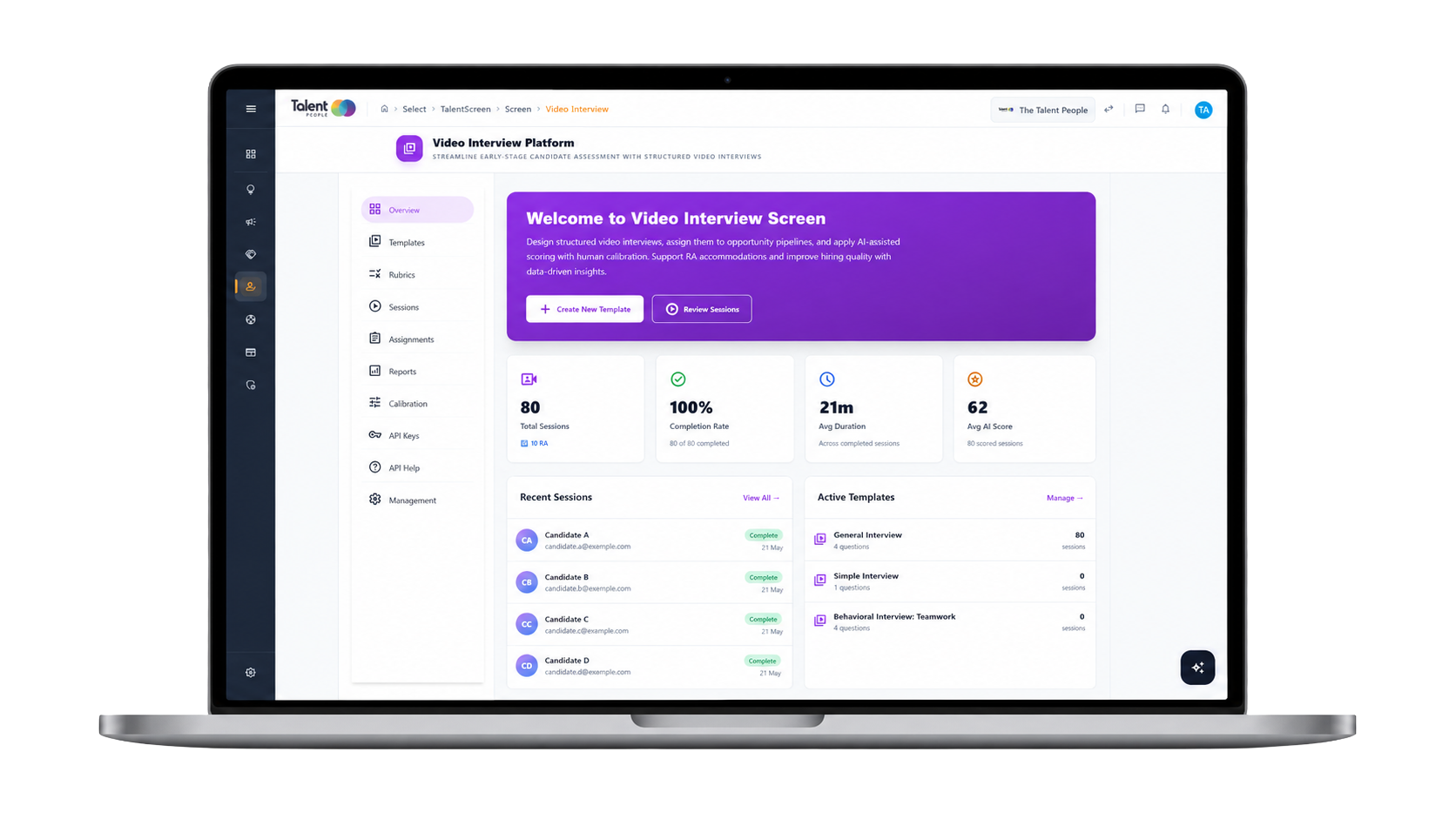
The Video Interview Platform was designed with ICO and DSIT requirements as a starting point, not a retrofit. Every candidate is scored against a role-specific rubric defined before any candidate completes the assessment. Individual calibration removes the normative comparison that creates adverse impact risk. Live bias monitoring surfaces scoring anomalies before they become decisions. Every response is transcribed and every score is documented.
Talent Assess provides the criteria-led selection layer: a fixed rubric, no comparative ranking, no training on historical hire data, and full adverse impact reporting by social mobility indicators, disability, ethnicity and gender. Immersive Work Experience removes access barriers from the pipeline entirely. It is on-demand, device-agnostic and requires no geographic proximity or prior connection to the firm.
The Talent People is a certified social enterprise, backed by Nesta. For firms with published social mobility commitments or Social Value Act obligations, every programme we run generates independently verified SROI data. This is particularly relevant for firms participating in the Social Mobility Employer Index, where supplier partnerships are an increasingly scrutinised dimension of the submission.
Relevant products
Social enterprise
The Talent People is a certified social enterprise. For financial services firms with published social mobility commitments or Social Value Act obligations, partnering with a verified social enterprise generates independently evidenced impact. This is particularly relevant for firms participating in the Social Mobility Employer Index, where supplier partnerships are an increasingly scrutinised dimension.
Common questions
What do ICO and DSIT requirements mean for AI recruitment tools in financial services?
The ICO’s 2024 audit of AI recruitment tools found that some commercially available systems were filtering candidates on protected characteristics without the employer’s knowledge. DSIT’s Responsible AI in Recruitment Guidance, published in response, requires employers using AI-assisted selection tools to implement live bias monitoring, conduct algorithmic impact assessments before deployment, and maintain documented audit trails for every individual selection decision. For financial services firms, where the FCA’s SM&CR framework adds a further layer of individual accountability, these requirements are not advisory. Tools that cannot produce a complete, explainable record of every decision create regulatory and reputational exposure that most legal and compliance teams will not accept.
How do I evidence social mobility progress in financial services recruitment?
The Social Mobility Employer Index is the recognised benchmark for the sector. Firms entering the Index are asked to provide data across seven areas including recruitment processes, workplace culture, and supplier partnerships. The scrutiny has shifted: what the Index assesses is evidence of measurable progress, not intention. Useful data points include socioeconomic background of applicants and hires, adverse impact analysis by social mobility indicators at each stage of the process, and supplier-level social impact data. The Talent People is a certified social enterprise with independently verified SROI data on every programme: data that is directly usable in SMEI submissions.
What does the financial services skills shortage actually look like?
The Financial Services Skills Commission’s 2024 Future Skills Report is the most comprehensive current picture. Key findings: 3 in 100 roles remain unfilled. The same specialist roles (data, software, cyber, risk) have been hardest to fill since 2022, with product managers joining that list for the first time in 2024. Apprenticeship starts have plateaued at 11,000 per year, down from 15,000 before 2017. Graduate entrants as a share of all UK graduates have halved. The FSSC is calling on firms to offer upskilling to the 16% of colleagues with identified skills proficiency gaps, and has launched a sector Skills Compact with government in November 2025 to accelerate action.
How do I reduce coaching bias in financial services graduate recruitment?
Psychometric tests and assessment centres are the primary selection tools in most financial services graduate programmes. Both are known to produce outcomes that correlate with socioeconomic background: test preparation materials are commercially available and disproportionately accessed by candidates from higher-income households; assessment centre performance correlates with confidence developed through prior exposure to formal interview environments. Reducing coaching bias requires changing what you measure. Talent Assess generates evidence of motivation and capability through engagement: what candidates do over time, not how they present on the day. This produces selection data that cannot be coached and is not dependent on prior access or social confidence.